
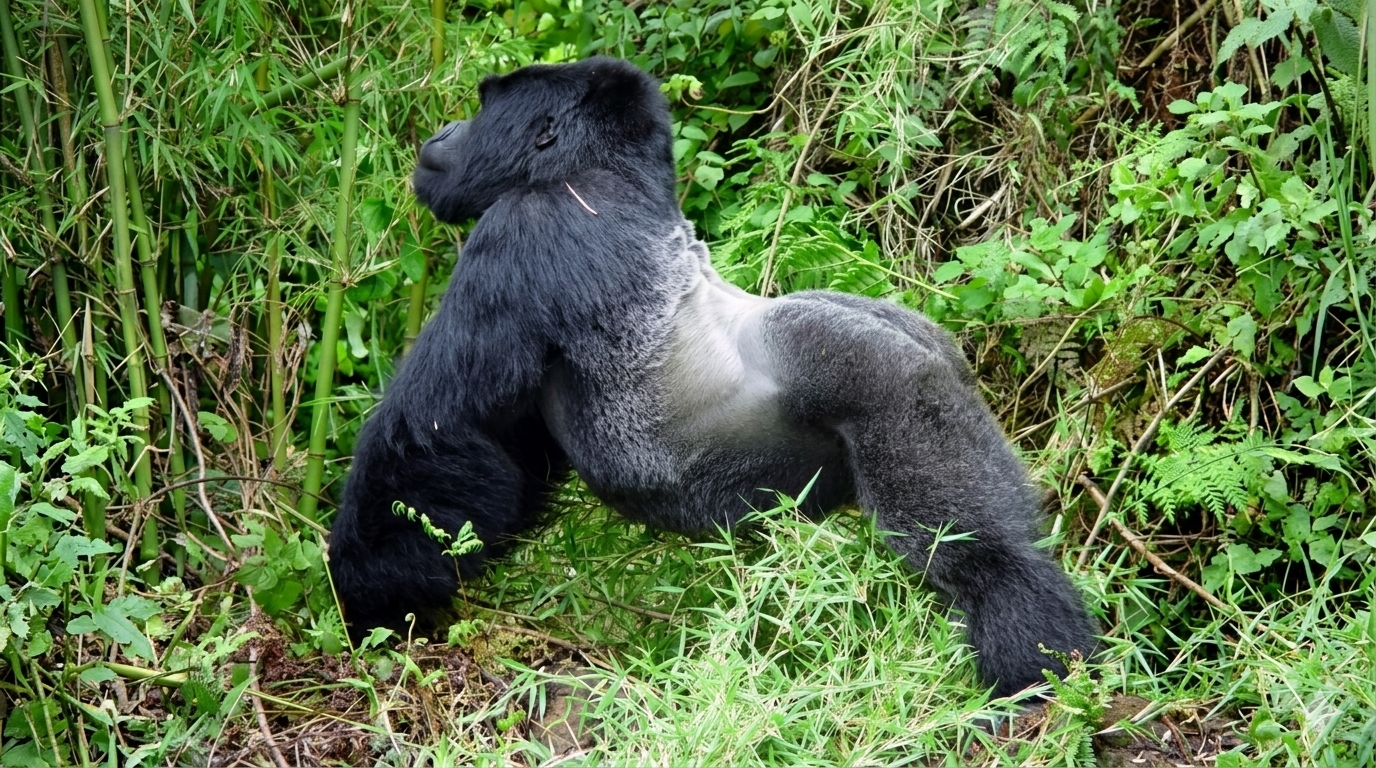
Silverback gorillas are the largest living primates on Earth and among Africa’s most fascinating wildlife. Along with chimpanzees and bonobos, they are our closest living relatives, sharing about 98% of their DNA with humans. Gorillas are found in the forests of Central, East, and West Africa and are divided into two main species: eastern and western gorillas. Western gorillas include the western lowland and Cross River gorillas, while eastern gorillas include the mountain gorilla and eastern lowland gorilla, also known as Grauer’s gorilla. The eastern lowland gorilla is the largest subspecies, while the Cross River gorilla is one of the rarest. Mature males are called silverbacks because of the distinctive silver-grey hair on their backs. They normally lead and protect their family groups, which include females, infants, and younger gorillas. Gorillas are social animals and spend much of their day feeding on leaves, stems, fruits, and other vegetation, as well as resting, grooming, and caring for their young.
Gorillas face major threats including habitat loss, poaching, human-wildlife conflict, and disease. Mountain gorillas, found in Uganda, Rwanda, and the Democratic Republic of Congo, are among the most protected and closely monitored populations. In Uganda, visitors can experience these incredible animals in places such as Bwindi Impenetrable National Park and Mgahinga Gorilla National Park. Gorilla trekking offers a rare opportunity to observe gorilla families in their natural forest habitat while contributing to conservation and local communities. Visitors are required to follow park guidelines, maintain a safe distance, and listen to their guides and trackers. Meeting a silverback in the misty African forest is an unforgettable experience, offering a unique glimpse into the lives of one of our closest relatives and reminding us why protecting these magnificent animals and their forests is so important.
Size, height and lifespan of Silverback Gorilla
Gorillas live in groups or families led by a Silverback. Silverback doesn’t refer to a particular species of gorillas but a mature male gorilla. Silverback gorillas are distinguished by a grayish white hairline around the back and shoulders. A male gorilla that is too old to be a juvenile but too young to be a silverback is referred to as a blackback. A silverback is much larger than a female. Compared to a female, a silverback gorilla has a larger head, body and can weigh up to 270 kilograms. A male gorilla becomes an adult at about 8 years of age. This is the time most leave the group to leave alone or join other males. At this point, they are still referred to as Blackbacks. It is only when they become fully grown (at about 12 to 13 years of age) that they become silverbacks. This is also the time when the hair down their back and across the shoulders becomes whitish or greyish in color.
A mature and lone silverback will live close to a particular group and attempt to dethrone the dominant silverback as soon as he is strong enough. If he fails to dethrone a leader of a particular gorilla family, he will attempt to steal females from that group to form his own.
It is important to note that some males never leave their original group on reaching maturity. They will stay loyal to the dominant silverback and help protect the group from intruders. This arrangement is more common with mountain gorillas and rare with Western lowland gorillas.
Whereas it is possible to find several silverback gorillas in a group, there is only one dominant silverback. The dominant silverback is the leader of the group and has absolute authority. He dictates what it to be done and when. He determines when to eat, rest and is entitled to mate with all the females in the group. Gorilla mating is often initiated by the female upon reaching maturity. The dominant silverback controls a group containing between 5 to 35 individuals. A gorilla group contains several females, adolescents, infants and some adult males. Females leave the group upon reaching maturity to avoid mating with the father.
Strength of a silverback gorilla?
A fully grown silverback gorilla is about twice the weight of an adult man. They are over 9 times stronger than an adult male. Their body weight and incredible strength is all because of a higher ratio of muscle mass. Would a strong adult male have a chance against a silverback in a duel? Whereas no fight has been recorded between an adult male and a silverback gorilla, it is obvious who the winner will be. An angry silverback would beat the man to a pulp. That side silverback gorillas are not aggressive unless threatened.

Are silverback gorillas aggressive?
The dominant silverback gorilla leads by charisma and example. He is always peaceful and rarely uses force. A silverback gorilla only becomes aggressive when it encounters a threat, intruders or if he wants to assert dominance. Intruders can mean males from other groups, stubborn members of his group, animals like leopards or humans visiting a group that is not habituated. When a silverback gorilla recognizes a threat or silverback from another group, he will first attempt to warn off the intruder. He does this by standing up while drumming up his chest.
If the above action doesn’t work, he will tear up and through plants at the intruder while making a deafening sound. The silverback will then make a mock attack using all four legs. If all this doesn’t work and the threat or intruder hasn’t yet got the message, the silverback will attack directly and deliver a blow with the hands or teeth. A silverback gorilla will defend his group and especially infants to the death. It is one reason why poachers and pet traders target the silverback if they wish to capture an infant.
What do silverback gorillas eat?
Silverback gorillas in general eat mainly plants. This can consist of fruits, shoots and leaves. They also love termites, ants and certain insects. Mountain gorilla silverback diet is slightly different. It consists of mainly stems and leaves. They may also feed on fungi, flowers and bark. The season (rainy or dry) determines which kind of food is prevalent. In general mountain gorillas live a life of plenty because they are exposed to a greater variety of vegetation than the other gorilla sub-species. Isn’t odd that that such massive and strong creatures do not eat meat?
Where to see silverback gorillas
Silverback gorillas are found in the dense tropical forests of East, Central, and West Africa. Lowland gorillas mainly inhabit forests and swampy areas within the Congo Basin, while mountain gorillas live in the high-altitude forests of the Virunga region and Bwindi Impenetrable Forest. Eastern lowland gorillas can be found in areas of the Democratic Republic of Congo, including Kahuzi-Biega National Park, Maiko National Park, Tayna Gorilla Reserve, the Itombwe Massif, and the Usala Forest.
Western lowland gorillas have a much wider distribution and are found in Gabon, the Democratic Republic of Congo, Angola, the Central African Republic, Cameroon, Equatorial Guinea, and the Republic of Congo. Mountain gorillas, one of the world’s most endangered gorilla subspecies, are found only in four protected areas: Mgahinga Gorilla National Park and Bwindi Impenetrable National Park in Uganda, Volcanoes National Park in Rwanda, and Virunga National Park in the Democratic Republic of Congo. These protected forests provide a safe habitat for gorilla families and offer visitors the opportunity to experience these magnificent animals in their natural environment.



Yo, has anyone else tried 88winapp? Downloaded it and was surprised by how smooth everything runs. Games load fast, haven’t had any crashes. If you’re looking for a solid mobile experience, definitely check out 88winapp.
**mitolyn reviews**
Mitolyn is a carefully developed, plant-based formula created to help support metabolic efficiency and encourage healthy, lasting weight management.
**prodentim reviews**
ProDentim is a distinctive oral-care formula that pairs targeted probiotics with plant-based ingredients to encourage strong teeth, comfortable gums, and reliably fresh breath
Your point of view caught my eye and was very interesting. Thanks. I have a question for you.
Can you be more specific about the content of your article? After reading it, I still have some doubts. Hope you can help me.
hello world
hello world
esomeprazole 40mg over the counter
esomeprazole 40mg over the counter
doryx 200 mg tablet
doryx 200 mg tablet
tadalafil 20mg mexico
tadalafil 20mg mexico
vidalista 80 price
vidalista 80 price
imodium age minimum
imodium age minimum
domperidone lactation
domperidone lactation
generic revatio
generic revatio
ED drug safe purchase
ED drug safe purchase
sildenafil pharmacy price differences
sildenafil pharmacy price differences
avanafil food interaction safety notes
avanafil food interaction safety notes
avanafil price comparison factors
avanafil price comparison factors
how long vardenafil lasts
how long vardenafil lasts